

Talking About a Revolution
Songs, Poems, Letters and Treaties from Revolutionary Times

By the rude bridge that arched the flood,
Their flag to April’s breeze unfurled,
Here once the embattled farmers stood,
And fired the shot heard round the world.
1st Verse of Concord Hymn, by Ralph Waldo Emerson.
Many words have been spoken, many songs sung, and many myths created around the American revolution. Following riots, uproar and a touch of tea spillage in Boston Harbour an aristocratic Northumbrian arrived in port to pitch his gosling green officers and scarlet soldiers into the frae. His arrival was impeccably timed for a shot at glory. Hiding out in the countryside, the revolutionaries had been tipped off by a lone night rider, of British intentions to relieve them of their arms stores, and were ready and waiting for the red coats. But contrary to popular myth, it wasn’t Paul Revere who had ridden out alone. Poetic licence was at play. As it turns out it was one Samuel Prescott who rode through the night to warn the revolutionaries – or if you prefer American Patriots – of imminent British attack. (Like all Americans Bob Dylan’s reference to the reincarnation of Revere’s horse in Tombstone Blues was probably picked up in school, through Henry Wadsworth Long fellow’s brilliant poem Paul Revere’s Ride.) Following the first shot of at Lexington – Emerson’s shot heard ‘round the world – Percy marched his scarlet men to the rescue of retreating British troops to the tune of Yankee Doodle. The lyrics mocked the Yankies by suggesting they were effeminate dandies who thought they were stylish by sticking a feather in their hats. A macaroni, by the way, was an extremely flamboyant wig; soon. afterwardsYankee Doddle would transform into an American Patriotic song.
Yankee Doodle went to town
A-riding on a pony,
Stuck a feather in his cap
And called it macaroni.
Yankee Doodle keep it up,
Yankee Doodle dandy,
Mind the music and the step,
And with the girls be handy.
The serious fight for ultimate supremacy had only just begun. One year later the British threw everything they could at the revolutionaries. In Philadelphia Jefferson was busily coining pithy phrases as British ships gathered in waters around New York.
“These United Colonies are, and of right ought to be Free and Independent States, that they are absolved from all allegiance to the British Crown, and that all political connection between them and the State of Great Britain, is and ought to be totally dissolved.”
And, the paradigm shifting:
“We hold these truths to be self-evident, that all men are created equal, that they are endowed by their Creator with certain unalienable Rights, that among these are Life, Liberty and the pursuit of Happiness.”
The ensuing tumult engulfed everyone from rank-and-file teenagers, to natives, to the enslaved, and war refugees. The revolutionaries pledged their fortunes to the battle ahead, and so did Hugh Percy. On the very same day Congress voted for Independence the British landed an extraordinary expeditionary force on Staten Island. Percy – heir to the Northumberland Estates – was charged with successfully leading troops at the subsequent Battles of Brooklyn, Fort Washington, and Newport. Eventually frustrated with the way British generals were conducting the war he resigned his rank in the spring of ‘77. On returning home he had spent ten thousand pounds of his own fortune, all his pay, and upwards of twenty-five thousand pounds remitted to him by the Duke and Duchess.
New York would remain in British hands for seven years, but finally the tables were starting to turn against them. Following Washington’s daring Christmas night crossing of the icy Delaware to surprise Hessian soldiers under British command any setbacks or stalemates were wiped out by a series of victories: from Trenton and Princeton, to Saratoga, and from Freehold (the same place later immortalised as Springsteen’s My Hometown) to Kings Mountain. Two years after the military defeat of the British at Yorktown, the details of Treaty of Paris peace agreement were, somewhat ironically, hammered out in London. Both sides were spent. To this day, only Article One of the Treaty remains in force, but its significance speaks for itself:
“His Brittanic Majesty acknowledges the said United States, viz., New Hampshire, Massachusetts Bay, Rhode Island and Providence Plantations, Connecticut, New York, New Jersey, Pennsylvania, Maryland, Virginia, North Carolina, South Carolina and Georgia, to be free sovereign and independent states, that he treats with them as such, and for himself, his heirs, and successors, relinquishes all claims to the government, propriety, and territorial rights of the same and every part thereof.”
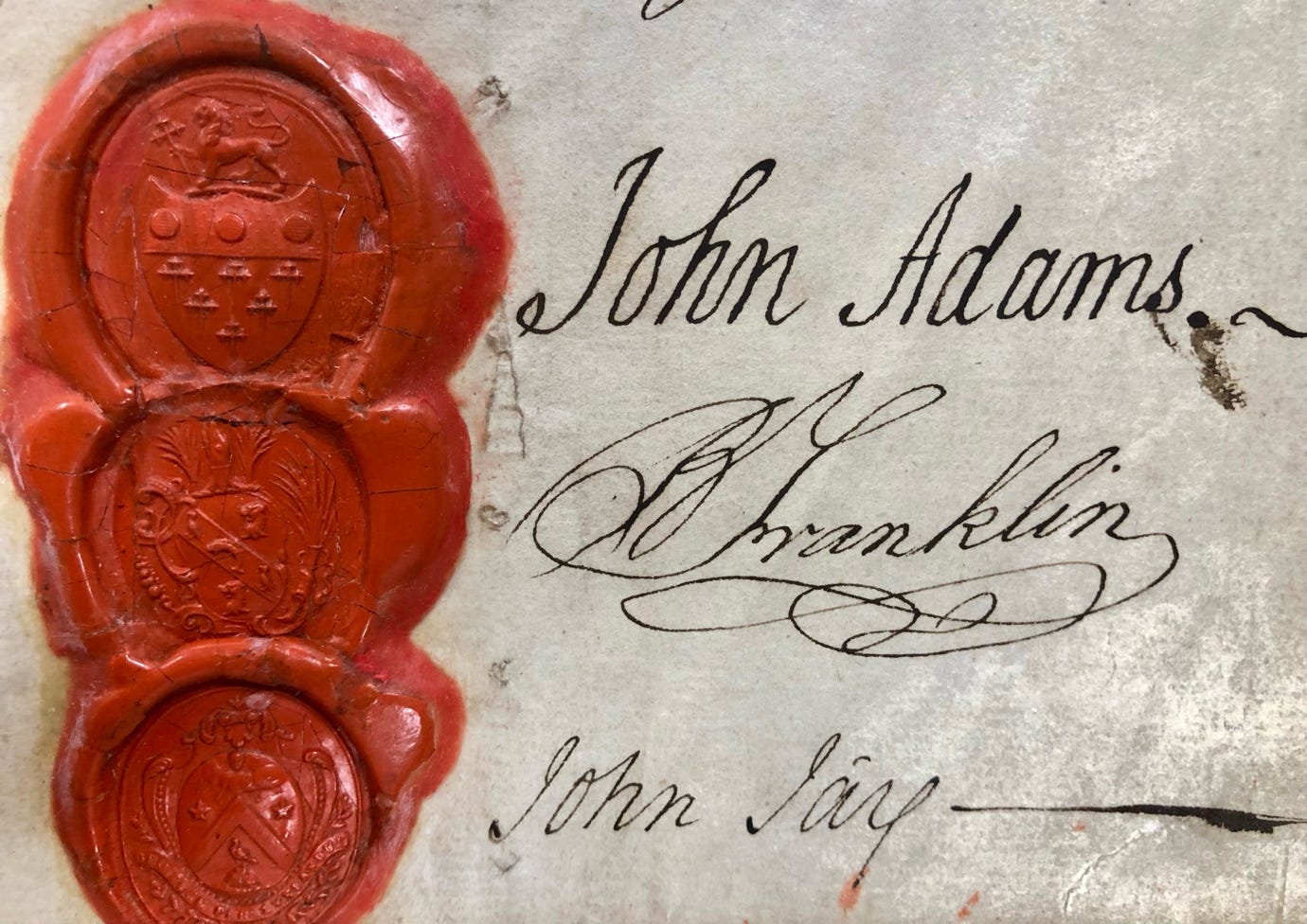
Here the story becomes personally tangible. At the National Archive in London, the red bound treaty was casually placed in my hands. Thumbing through to the back of the deal, there, in all their glory, were the signatories’ names, sealed with wax stamps: Adams, Franklin, Jay. In line with long tradition the language was sycophantic in style; just check how many titles King George III had:
“It having pleased the Divine Providence to dispose the hearts of the most serene and most potent Prince George the Third, by the grace of God, king of Great Britain, France, and Ireland, defender of the faith, duke of Brunswick and Lunebourg, arch‐ treasurer and prince elector of the Holy Roman Empire etc., and of the United States of America, to forget all past misunderstandings and differences that have unhappily interrupted the good correspondence and friendship which they mutually wish to restore…”
But how bloody the whole Revolution was: upwards of 35-40,000 Americans died in pursuit of the Republic and fires would require stamping out for some time afterwards. From the North Atlantic shores of the new world, American patriot success inspired a wave of enlightenment-infused revolutions, spreading notions of equality, liberty, and sovereignty from France to the Caribbean and back to Europe. As Revolutionary zeal spread to France, the dramatic rise of Napoleonic power kept the British Military occupied in Europe and transatlantic geopolitical poles spinning.
Around this time Beethoven’s 3rd symphony was premiered in Boston. In apparent disgust with Napoleon proclaiming himself Emperor, Beethoven removed the dedication to the Little Corporal and renamed the piece the Heroic Symphony. Out at sea ensuing Anglo-French warfare required British controls on American shipping and her sailors, which hit the fledgling United States economy hard. To add fire to the flames the British were also supplying weapons to Native Americans to assist in subduing westward expansion. So as to make clear their displeasure with all this, and pursue territorial claims on Canada, America’s ‘hawks’ declared war on the British.
“Be it enacted, That war be and the same is hereby declared to exist between the United Kingdom of Great Britain and Ireland and the dependencies thereof, and the United States of America…
Declaration of 12th Congress, 1st Session, June 18 1812. (War of 1812-1815.)
By the spring of 1814, Napoleon Bonaparte was temporarily ensconced on the island of Elba, freeing up battle-hardened British troops to launch offensives along the American East Coast. Penetrating inland, they arrived at the Whitehouse in August 1814, where they were greeted by a table laden with food for forty. Expecting an American victory over the British, the menu had been prepared by the President’s spouse, but the day was not theirs, and the table was abandoned. After tucking into “decanters of ale, cider and wine placed in coolers, plate warmers by the fire and a variety of meats on the spits,” the Brits torched the place. Thankfully, for all our histories, some lower-ranking clerks stuffed the Declaration of Independence, the Constitution, and George Washington’s correspondence into hastily made linen bags for safe-keeping in an abandoned Georgetown mill.
After a night and day of burning, the British withdrew in an almighty storm. Washington’s glowing skies could be seen fifty miles away in Baltimore, where a second battle was brewing. At sea, Royal Naval ships Volcano, Devastation, and Terror had something other than a picnic planned. On September 14th, the British launched a relentless 25-hour bombardment of Fort McHenry. Witnessing the flare of the night’s rocketry aboard HMS Surprise, a lone American observer began composing a poem on the back of a letter. On release, he revised the four verses about America’s victorious defence. That man was Francis Scott Key, and his poem “Defence of Fort McHenry.” would, be set to a British popular song, To Anacreon in Heaven, to become The Star-Spangled Banner:
The Star-Spangled Banner
O! say can you see by the dawn’s early light,
What so proudly we hailed at the twilight’s last gleaming,
Whose broad stripes and bright stars through the perilous fight,
O’er the ramparts we watch’d, were so gallantly streaming?
And the rockets’ red glare, the bombs bursting in air,
Gave proof through the night that our flag was still there,
O! say does that star-spangled banner yet wave,
O’er the land of the free, and the home of the brave?
On Christmas Eve of 1814, officials from both sides signed the Treaty of Ghent, signalling the end of a costly war for both nations. But there was one final twist in the tale. News of the signing took more than a month to cross the Atlantic, arriving too late to stop Andrew Jackson’s “makeshift army of ruffians, hillbillies, pirates, and militiamen from squaring off in a field of sugarcane stubble” against seasoned British soldiers. The Battle of New Orleans became “one of the most lopsided victories in military history” and it made for a good song. From a shot around the world to a field of sugarcane stubble, American identity was forged not only by battle cries and treaties, but by songs and poetry.
The Battle Of New Orleans
In 1814 we took a little trip
Along with Colonel Jackson down the mighty Mississip.
We took a little bacon and we took a little beans
And we caught the bloody British in the town of New Orleans.
We fired our guns and the British kept a’comin. There wasn’t nigh as many as there was a while ago. We fired once more and they began to runnin’ on Down the Mississippi to the Gulf of Mexico.
Coda:
Songlines include:
Talking About A Revolution – Tracey Champman
Tombstone Blues – Bob Dylan
Trudy and Dave – John Hiatt
Yankee Doddle – British Version – Richard Shuckburgh
My Hometown – Bruce Springsteen
Star Spangled Banner – Francis Scott Key
The Battle of New Orleans – Jimmy Driftwood